01
Named assignments
Attach a performer, device, service, or other description to each monitored frequency or band.
Signal Watchdog monitors a defined list of frequencies or bands and reports whether each is clear or occupied—now and across recent history—without requiring someone to stare at a full spectrum trace.
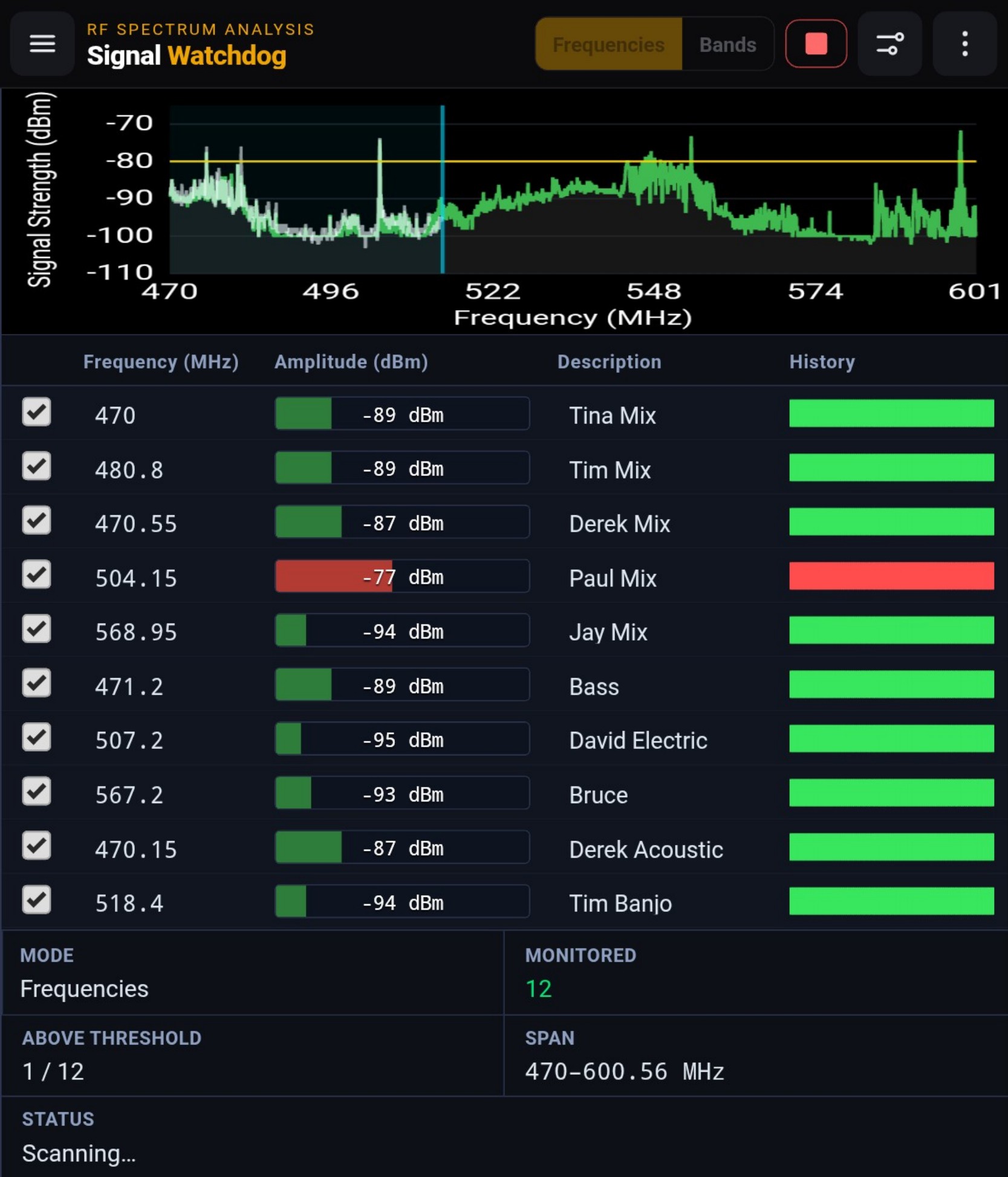
Signal Watchdog sweeps a defined span, extracts the strongest measurement for each selected row, and compares it with the threshold you establish. The table presents the current amplitude and a rolling clear-or-occupied history for every entry.
Use it for wireless microphones, broadcast channels, repeaters, control links, telemetry, or any known allocation where an unexpected signal—or the disappearance of an expected one—deserves attention.
The underlying sweep remains visible, but the watch list translates it into the named frequencies and bands that people actually manage.
Attach a performer, device, service, or other description to each monitored frequency or band.
Amplitude bars show current strength and change color when a row crosses the configured level.
Recent green and red samples reveal whether occupancy is isolated, intermittent, or persistent.
Monitor specific frequencies or the strongest signal anywhere within defined bands.
Establish the swept range and the dividing line between clear and occupied.
Build a watch list that reflects the channels, people, or systems being managed.
Use current amplitude and the last 100 sweeps to identify changes and their persistence.
Frequency and band modes let the same instrument serve narrow channel assignments and broader allocations.
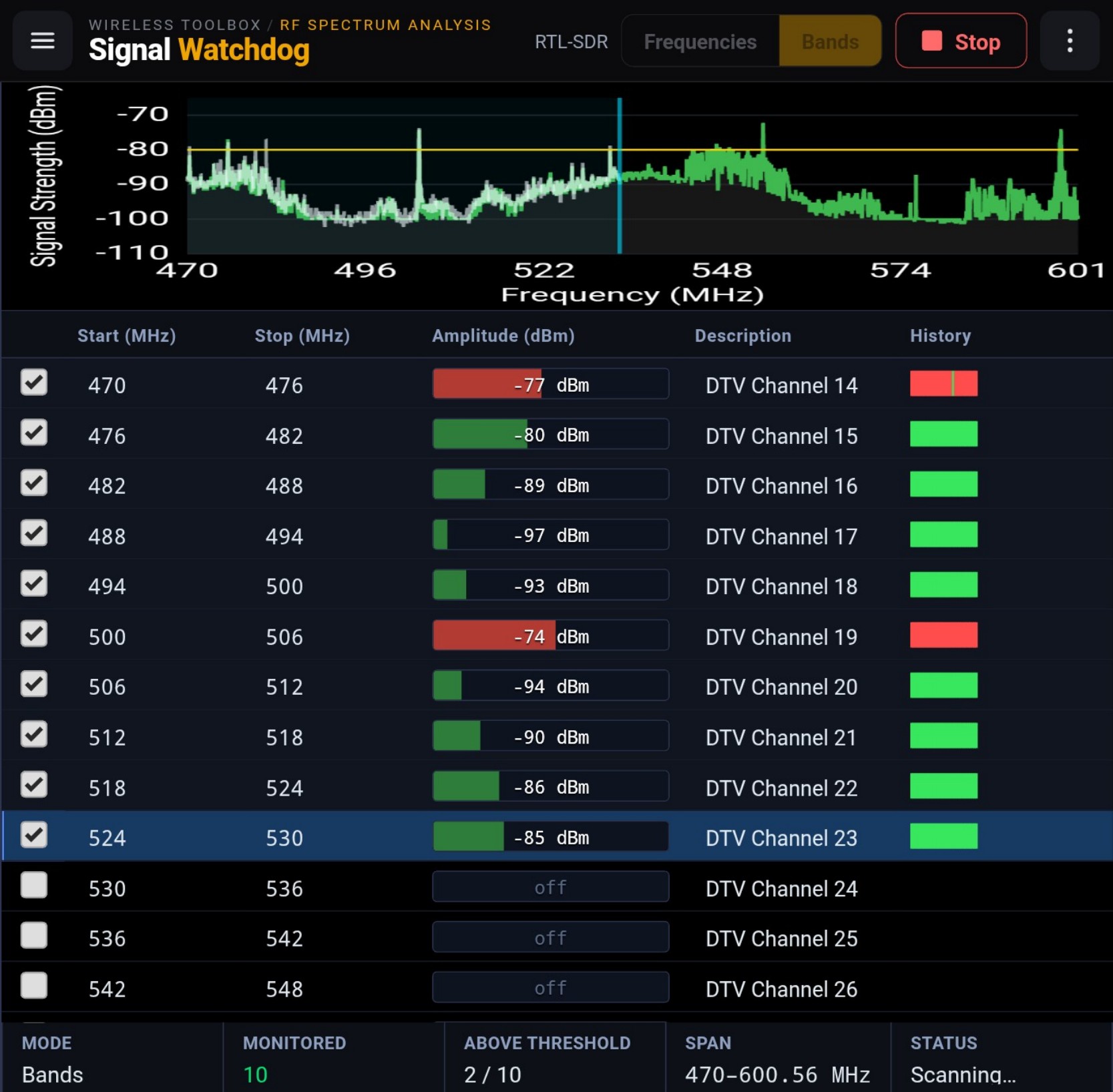
Signal Watchdog keeps attention on the frequencies that matter while preserving enough history to understand the event.